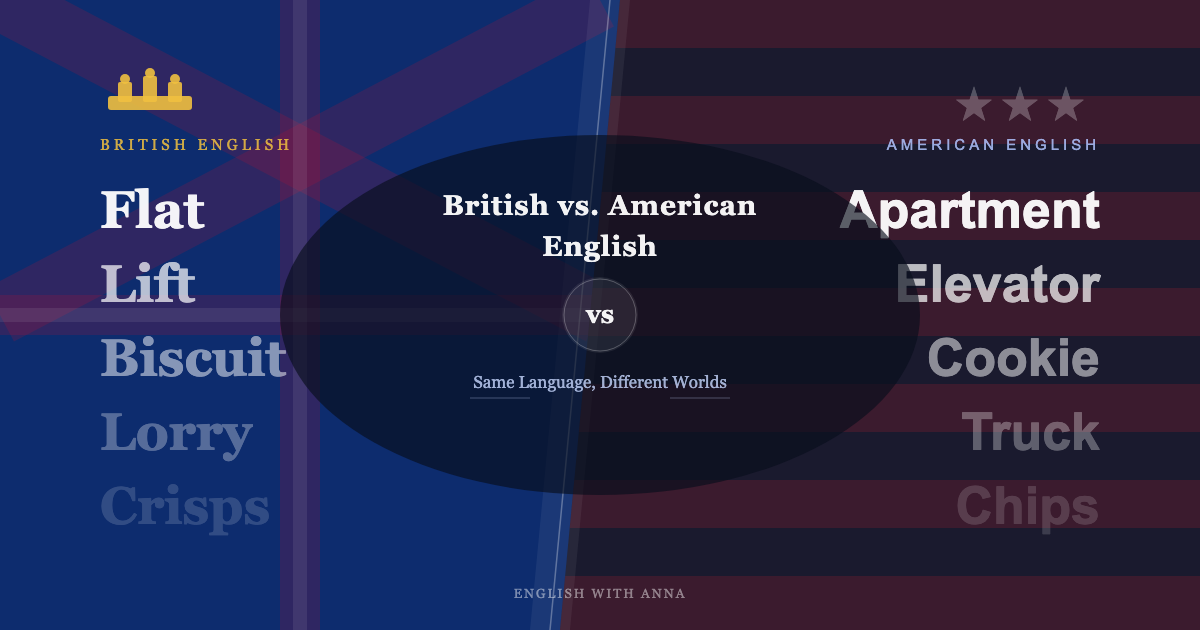
British vs. American English: Same Language, Different Worlds
 AnnaJune 26, 2026
Have you ever watched a British TV show and wondered why people are talking about "lorries," "crisps," and "holidays" when they aren't discussing trucks, chips, or vacations? Or perhaps you've read an American article and been puzzled by words like "apartment" instead of "flat" or "sidewalk" instead of "pavement."
Welcome to the fascinating world of British and American English—two versions of the same language that have evolved in surprisingly different ways.
A Shared History with Different Paths
British and American English both originated from the English spoken in England during the 17th century. When settlers crossed the Atlantic and established colonies in North America, they brought their language with them.
Over time, however, the two regions developed independently. Influences from immigrants, cultural changes, technological developments, and even deliberate spelling reforms caused the language to evolve differently on each side of the ocean.
Today, British and American English remain largely mutually intelligible, but they differ in vocabulary, spelling, pronunciation, and even grammar.
Vocabulary: The Most Noticeable Difference
The easiest way to spot whether someone is using British or American English is through vocabulary.
Here are some common examples:
British English
American English
Flat
Apartment
Lift
Elevator
Holiday
Vacation
Lorry
Truck
Biscuit
Cookie
Crisps
Chips
Chips
French Fries
Petrol
Gasoline
Pavement
Sidewalk
Boot (of a car)
Trunk
Imagine an American asking for chips and receiving fries, while a British visitor expects potato crisps. Small misunderstandings like these can lead to amusing conversations.
The Great Spelling Divide
One of the most famous differences between British and American English is spelling.
In the early 19th century, American lexicographer Noah Webster advocated for simplified spellings, believing they better reflected pronunciation and helped establish a distinct American identity.
As a result, many words are spelled differently today:
British English
American English
Colour
Color
Favourite
Favorite
Centre
Center
Theatre
Theater
Organise
Organize*
Traveller
Traveler
*Interestingly, both "organize" and "organise" are accepted in British English, although "organise" is more commonly used.
These spelling differences may seem minor, but they instantly reveal which variety of English a writer is using.
Pronunciation: More Than Just an Accent
Pronunciation differences go far beyond accents.
One well-known distinction involves the letter "r." Most American accents pronounce the "r" clearly in words such as "car" and "hard." Many British accents, particularly Received Pronunciation, soften or omit the final "r" sound.
Other words have completely different pronunciations:
Advertisement
Schedule
Tomato
Vitamin
Garage
For example, Americans often pronounce "schedule" with a "sk" sound, while many Britons use a "sh" sound.
These variations contribute to the unique rhythm and character of each version of English.
Grammar Differences That Might Surprise You
Although grammar differences are less obvious, they do exist.
Present Perfect vs. Simple Past
British speakers often use the present perfect tense where Americans prefer the simple past.
British English: "I've just eaten lunch."
American English: "I just ate lunch."
Both are correct, but their frequency differs.
Collective Nouns
British English often treats collective nouns as plural.
British English: "The team are playing well."
American English: "The team is playing well."
Again, neither is wrong—it's simply a matter of convention.
Which Version Is Better?
The short answer: neither.
British and American English are simply different versions of the same language. One isn't more correct, sophisticated, or useful than the other.
The best choice depends on your audience:
Writing for the UK? Use British English.
Writing for the United States? Use American English.
Writing for an international audience? Consistency matters more than the variety you choose.
Mixing spellings such as "color" and "favourite" in the same document can appear unprofessional, so it's generally best to stick with one style.
Why These Differences Matter
Understanding the differences between British and American English does more than improve communication. It offers a fascinating glimpse into history, culture, and the evolution of language.
The next time someone asks you to put your luggage in the boot, ride the lift, or buy some crisps, you'll know exactly what they mean—and perhaps appreciate how a single language can develop into two wonderfully distinct varieties.
After all, whether you say "holiday" or "vacation," "lift" or "elevator," English remains a language rich in diversity, character, and endless opportunities for connection.
Keep reading
- Language & CultureDifferences in Greetings in English and RussianJuly 13, 2026
- Language & CultureLost in Translation: The Logic of English vs. Russian and Why We Misunderstand Each OtherJune 18, 2026
- Language & CultureLanguage Shock: Why English and Russian Are Two Different Operating Systems for the BrainJune 11, 2026