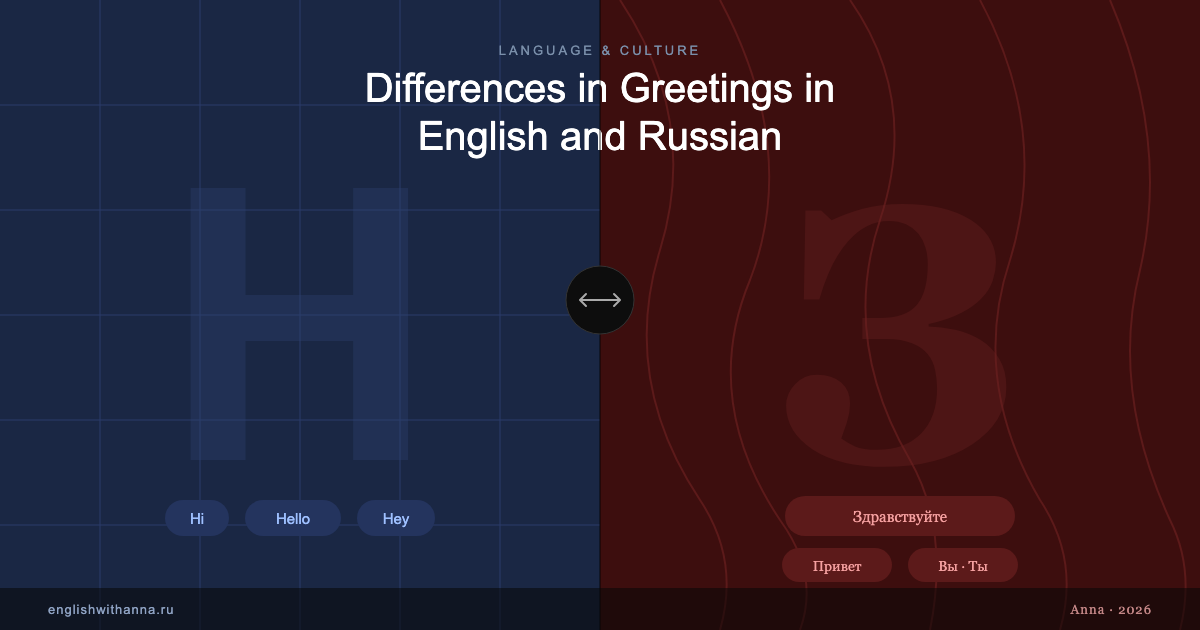
Differences in Greetings in English and Russian
 AnnaJuly 13, 2026
Greetings are one of the first things language learners encounter when studying a foreign language. While saying "hello" may seem simple, greetings often reflect deeper cultural values and social norms. English and Russian greetings share some similarities, but they also differ in important ways. Understanding these differences can help language learners communicate more naturally and avoid misunderstandings.
Common Greetings in English
English speakers use a variety of greetings depending on the situation and level of formality.
Formal greetings include:
Good morning
Good afternoon
Good evening
Hello
Informal greetings include:
Hi
Hey
What's up?
How's it going?
In English-speaking countries, people often use friendly greetings even with strangers. For example, a cashier may say, "How are you today?" even when no detailed answer is expected.
Common Greetings in Russian
Russian also has formal and informal greetings.
Formal greetings include:
Здравствуйте (Hello)
Доброе утро (Good morning)
Добрый день (Good afternoon)
Добрый вечер (Good evening)
Informal greetings include:
Привет (Hi)
Здорово (Hey)
Приветик (Hi, in a very friendly way)
Russian greetings tend to be more dependent on the relationship between speakers. Choosing the wrong level of formality can sound impolite or overly familiar.
Formality Matters More in Russian
One of the biggest differences between English and Russian greetings is the importance of formality.
Russian speakers distinguish between:
Вы (formal "you")
Ты (informal "you")
When greeting a teacher, boss, older person, or someone you have just met, using formal language is expected. Switching to informal language usually requires mutual agreement or a closer relationship.
In English, the word "you" is used in both formal and informal situations, making greetings simpler in this respect.
Small Talk vs. Direct Communication
English-speaking cultures often use greetings as a way to start small talk.
For example:
How are you?
How's your day going?
How have you been?
In many cases, these questions are social rituals rather than genuine requests for detailed information. A simple response such as "I'm fine, thanks" is usually enough.
Russian speakers are often more direct. If someone asks "Как дела?" ("How are things?"), they may expect a more honest answer. Russians are generally less likely to engage in extensive small talk with strangers.
Smiling and Non-Verbal Communication
Greetings involve more than words. Non-verbal communication also differs between English-speaking and Russian cultures.
In many English-speaking countries, smiling during greetings is common and often expected. A smile is viewed as a sign of friendliness and openness.
In Russian culture, smiles are typically more reserved and often associated with genuine emotions rather than social courtesy. As a result, Russians may appear more serious during first encounters, even when they are being polite.
Greetings in Professional Settings
Business greetings in English tend to be friendly but professional.
Examples include:
Good morning, Mr. Smith.
Nice to meet you.
How are you today?
Russian business greetings are usually more formal, especially during initial meetings.
Examples include:
Здравствуйте.
Очень приятно познакомиться.
Добрый день.
Respect and professionalism are often emphasized through formal language and titles.
Common Mistakes Made by Learners
English learners of Russian often:
Use "Привет" in overly formal situations.
Switch to "ты" too quickly.
Underestimate the importance of formal greetings.
Russian learners of English often:
Forget to use small-talk greetings.
Sound overly formal in casual conversations.
Misinterpret questions such as "How are you?" as requests for detailed personal information.
Although English and Russian greetings may appear similar at first glance, they reflect different cultural expectations. English greetings often emphasize friendliness, informality, and small talk, while Russian greetings place greater importance on formality, social distance, and sincerity. By understanding these differences, language learners can communicate more naturally and build stronger relationships across cultures.
Keep reading
- Language & CultureBritish vs. American English: Same Language, Different WorldsJune 26, 2026
- Language & CultureLost in Translation: The Logic of English vs. Russian and Why We Misunderstand Each OtherJune 18, 2026
- Language & CultureLanguage Shock: Why English and Russian Are Two Different Operating Systems for the BrainJune 11, 2026