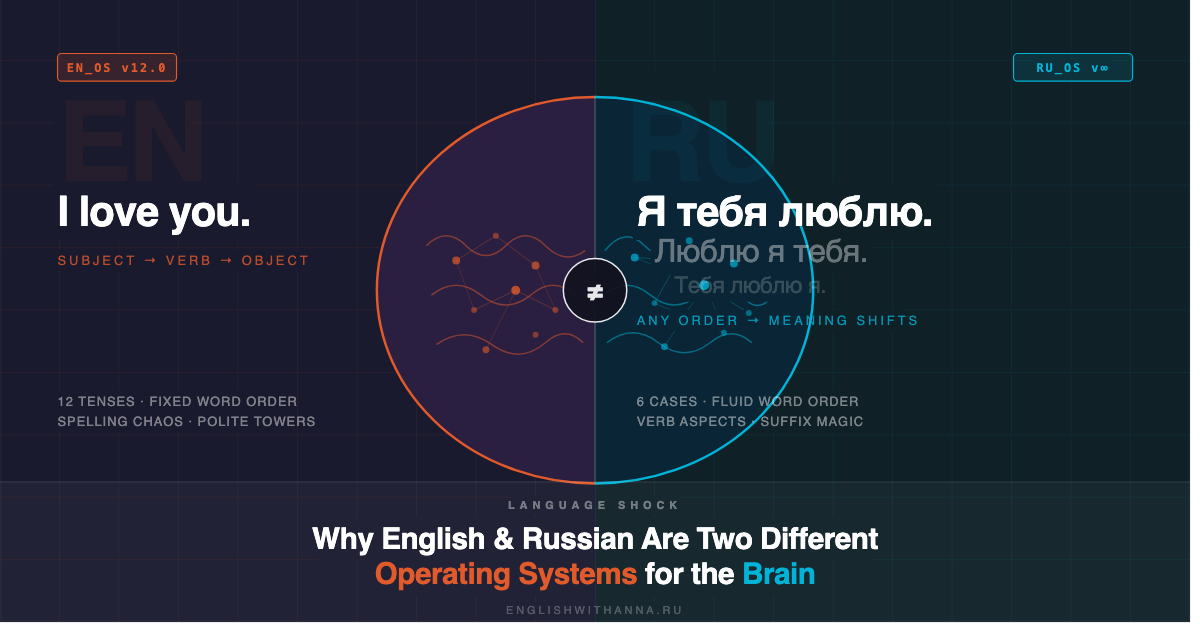
Language Shock: Why English and Russian Are Two Different Operating Systems for the Brain
 AnnaJune 11, 2026
Have you ever wondered why native English speakers sound like time-obsessed robots to foreigners?
Or why foreigners completely lose their minds over the Russian phrase "Да нет, наверное" (literally: "Yes no maybe")?
The truth is, our languages view reality from completely different angles.
Here are 5 crazy differences that turn translating between them into a psychological thriller.
1. Rigid LEGO vs. Flexible Play-Doh
English is like a strict German construction set.
It rules with an iron fist: Subject + Verb + Object.
You cannot just throw words out of the blueprint.
The phrase "I love you" has exactly one legal variation.
Russian is like soft Play-Doh.
Thanks to a complex system of word endings (cases), you can mix words however you like.
"Я тебя люблю", "Люблю я тебя", "Тебя люблю я"—all mean "I love you."
But each shift changes the dramatic emphasis.
An English speaker’s brain simply short-circuits at this point.
2. Time Management vs. The Philosophy of Action
English speakers are obsessed with time and control.
They have 12 grammatical tenses.
It is vital for them to show whether an action was a continuous process, a regular habit, or a result tied to next Wednesday.
The Russian philosophy is much simpler.
Time has only three states: past, present, and future.
Instead, Russians use a secret weapon: verb aspects.
To an English speaker, "I was writing a letter" and "I wrote a letter" belong to different grammatical eras.
To a Russian, it is just a question of whether the job got done.
3. Spelling Hell vs. Phonetic Torture
English reading rules are pure chaos.
The letters cough, tough, though, and through all rhyme with completely different words.
Linguists joke: "You write Liverpool, but you read it as Manchester."
To speak English, you must memorize how every single word is spelled and pronounced separately.
Russian is much easier to read.
In 90% of cases, you read exactly what is written.
But this is where the phonetic trap snaps shut.
Try making an American pronounce the Russian word "Выкарабкивающийся" (crawling out).
Or try explaining the difference between a hard "N" and a soft "N".
Spoiler: they hear it as the exact same sound.
4. Robotic Politeness vs. Soul Anatomy
Modern English erased the difference between "thou" and "you"—everyone gets the universal You.
But to avoid sounding rude, English speakers must build three-story towers of politeness.
"Could you please be so kind as to pass the salt, if it’s not too much trouble?"
Russian cuts straight to the chase.
There is a hard border: "Вы" for formal distance, and "Ты" for friends.
However, Russian has the magic of suffixes.
An English speaker just says cat.
A Russian can turn it into кошечка, котище, котяра, котенька, or кошак.
Each variation instantly shows exactly how you feel about the animal without extra words.
5. Concepts Untranslatable by Design
Both languages have cultural concepts that instantly evaporate during translation.
· How do you explain the Russian word "тоска" (toska) to a Londoner? It is not just sadness or boredom. It is an existential ache of the soul when you do not even know what is wrong.
· Conversely, how do you translate the English word "privacy" into Russian? It is not just solitude or private life. It is a sacred, culturally protected right to be left completely alone.
Learning a language is never about memorizing rules.
It is a complete rewiring of your mind.