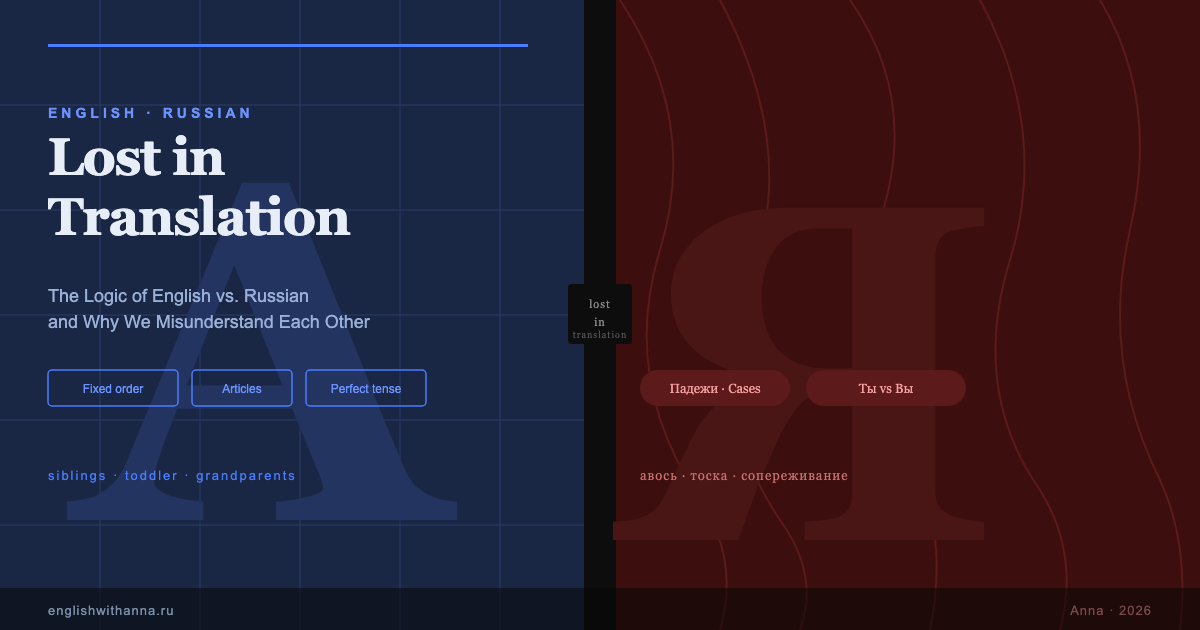
Lost in Translation: The Logic of English vs. Russian and Why We Misunderstand Each Other
 AnnaJune 18, 2026
Learning a foreign language is not just about swapping words; it is about rewiring how you think. We often find that concepts naturally expressed in one language require a whole paragraph of explanation in another.
English and Russian represent two completely different linguistic systems. Let's look at the striking differences that clearly illustrate this contrast in logic.
What English Has That Russian Lacks
1. Fixed Word Order
I n Russian, you can freely rearrange words. For instance, "I bought a car" can be said as "Я купил машину" (I bought car), "Машину купил я" (Car bought I), or "Купил я машину" (Bought I car). The meaning remains the same; only the emotional emphasis changes.
I n English, word order is strictly regulated: Subject + Verb + Object (I bought a car). If you break this structure, the sentence will either lose its meaning entirely or turn into nonsense.
2. Articles as Markers of Definiteness
It can be incredibly difficult for a Russian speaker to understand the necessity of A and The because the Russian language has no articles at all. Russians are used to conveying context through intonation or words like "this" or "some".
For a native English speaker, the article is a vital logical tool. It immediately clarifies whether you are talking about an abstract item among many (a cat) or a specific, already familiar one (the cat).
3. The Gerund
English has a highly convenient form known as the gerund (a verb ending in -ing), which functions as a noun. Perfect examples are shopping (the process of making purchases) or skiing (the activity of traveling on skis). In Russian, conveying this exact same logic often requires cumbersome verbal nouns or entire subordinate clauses, making sentences much heavier.
4. Precision of Tenses (The Perfect Group)
For an English speaker, it is crucial to separate a simple action in the past from an action whose result matters right now. The Russian phrase "Я потерял ключи"sounds exactly the same whether it happened five years ago or five minutes ago.
English syntax forces a choice: I lost my keys (a simple fact in the past) vs. I have lost my keys (meaning: "I am locked out of my house right now").
5. Ultra-Compact Words
English is highly economical. Where Russian requires a descriptive phrase of several words, English uses a single, precise concept:
· Siblings — instead of the lengthy Russian phrase "родные братья и сестры" (biological brothers and sisters).
· Toddler — instead of "ребенок, который только начинает ходить" (a child who is just starting to walk).
· Grandparents — a single word for grandmother and grandfather combined, whereas Russian always splits them up.
What Russian Has That English Lacks
1. Inflection (The System of Endings)
While English relies on word order, Russian maintains the logic of a sentence through a deeply developed system of cases, genders, and numbers. Word endings constantly change.For example, the word for "cat" (кот - kot) can change to кота, коту, котом, or о коте depending on its role in the sentence. It is these endings—not the position of the word—that show who is doing what to whom.
2. The Social Distance: "Ty" vs. "Vy"
In modern English, the pronoun You is a universal tool. You use it for a stray dog, your boss, or the King.
In Russian, there is a strict divide between "Ты" (Ty - informal "you") and "Вы" (Vy - formal/plural "you"). Choosing between them is a social minefield. Use the informal one with a stranger, and you are considered rude; use the formal one with a close friend, and you seem cold and distant.
3. Prefix Modification
To change the direction or nature of an action, English usually uses phrasal verbs (e.g., run away, run in, run out). Russian does the exact opposite: it attaches prefixes to the front of the root verb. By adding different prefixes to the verb бежать (to run), you get completely new verbs: убежать (to escape), прибежать (to arrive running), перебежать (to cross by running), or забежать (to drop in briefly).
4. Endless Diminutive Forms
English is somewhat limited when it comes to expressing affection through grammar—you mostly just add words like "little" or "cute." Russian possesses a massive variety of emotional suffixes. You can turn a regular cat (кот) into something incredibly affectionate like котик (kotik), котенок (kotenok), or котофей (kotofey) just by altering the suffix. Russians can make almost any noun sound sweet, including everyday items like soup or keys.
5. Untranslatable Cultural Concepts
Some Russian words reflect a specific psychological or cultural mindset and have no direct equivalents in English. They can only be understood through context:
· Avos’ (Авось): A blind faith that things will somehow work out on their own at the very last minute, without any planning, effort, or preparation. It is practically a national philosophy of relying on pure luck.
· Toska (Тоска): A deep, existential spiritual anguish or melancholy. Vladimir Nabokov famously explained it as a dull ache of the soul, a longing with nothing to long for. It is much deeper and heavier than just being "sad."
· Soperezhivanie (Сопереживание): While "empathy" or "sympathy" come close, this word literally translates to "co-experiencing." It means completely absorbing another person's emotional pain and feeling it right alongside them as if it were your own.
Conclusion: English is structured like a precise, logical Lego set where every piece must click into its assigned spot to maximize efficiency and save time. Russian, on the other hand, is a flexible, fluid instrument. By constantly changing the shapes and endings of the words themselves, it prioritizes deep emotional shades, warmth, and semantic nuances over strict structure.